logo

Home resources bms_chips_options

BMS chips options

A comparison of commercially available Integrated Circuits (ICs) for BMSs for large Li-Ion battery packs

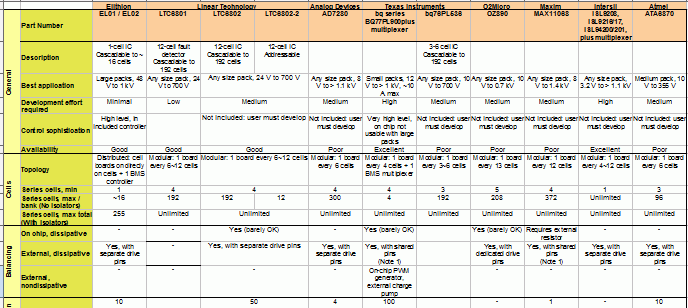
This table compares BMSs ICs available on the market today for large (> 50 V) Li-Ion battery packs.
Please see the BMS chips white paper for a more in-depth analysis.
This information does not constitute an endorsement of any of these companies and products.
While the information presented here is believed to be accurate, Elithion takes no responsibility for any errors.
Please send us comments, corrections and additions.
Elithion Linear Technology Analog Devices Texas Instruments
plus multiplexer
O2Micro Maxim Intersil
plus multiplexer
Atmel
General Part Number EL01 / EL02 LTC6802-1 / LTC6802-2 AD7280 bq series
(BQ77PL900)
OZ890 MAX11068 ISL9208
ISL9216/17
ISL94200/201
ATA6870
Best application Large packs, 48 V to 1 kV Any size pack, 24 V to 800 V Any size pack, 8 V to > 1.1 kV Small packs, 12 V to > 1 kV, ~10 A max Any size pack, 10 V to 0.7 kV Any size pack, 8 V to 1.4 kV Any size pack, 3.2 V to > 1.1 kV Medium pack, 10 V to 355 V
Development effort required Minimal Medium Medium High Medium Medium High Medium
Control sophistication High level, in included controller Not included: user must develop Not included: user must develop Very high level, on chip
not usable with large packs
Not included: user must develop Not included: user must develop Not included: user must develop Not included: user must develop
Availability Good Good Poor Excellent Poor Poor Excellent Poor
Cells Topology Distributed: cell boards on direcly on cells + 1 BMS controller Modular: 1 board every 12 cells Modular: 1 board every 6 cells Modular: 1 board every 4 cells + 1 BMS multiplexer Modular: 1 board every 13 cells Modular: 1 board every 12 cells Modular: 1 board every 4~12 cells Modular: 1 board every 6 cells
Series cells, min 1 4 4 4 5 4 1 3
Series cells, max / bank
(No isolators)
~16 LTC6802-1: 192
LTC6802-2: 12
300 4 208 372 Unlimited 96
Series cells, max total
(With isolators)
255 Unlimited Unlimited Unlimited Unlimited Unlimited Unlimited Unlimited
Balancing On chip, passive - Yes (barely OK) - Yes (barely OK) Yes (barely OK) Requires external resistor - -
External, passive Yes, with separate drive pins Yes, with separate drive pins Yes, with separate drive pins Yes, with shared pins (1) Yes, with dedicated drive pins Yes, with shared pins (1) Yes, with separate drive pins Yes, with separate drive pins
External, active - - - On-chip PWM generator, external charge pump - - - -
Current
Drain
Standby drain [uA] 10 50 4 100 - 1 - 10
Operating drain [mA] 1.5 1.5 1 ~ 30 0.25 - 2 - 15
Balance drain, @ 3.6 V [mA] 100~1000 (ext res) internal: 330
external possible
external 10 ~ 1000 - ~250 mA (ext res) - external
Readings Voltage measurement accuracy @ 3.6 V, 25 C [mV] 15 8 10 5 - 15 - 7
Cell voltage, min 2 0 0 2.3 - 0 - 0
Cell voltage, max 4.55 5 5 4.5 - 5 - 5
Temperature measurement Every cell 2 every 12 cells Every cell 1 for 4 cells - 2 for 12 cells - 2 every 6 cells
Readings rate 1s 13 ms ~10 us 1s - - - 8 ms
Data rate 5 kHz up to 1 MHz 10 kHz ~ 1 MHz 10 kHz ~ 1 MHz - 10 kHz ~ 1 MHz - up to 250 kHz
Communications Between adjacent boards: wires 1, current source 3, current sources (LTC6801-1) / logic levels (LTC6801-2) 7, current sources N.A. 3, optically isolated 4, capacitively coupled N.A. 8, current sources
Between banks and controller: wires 4 / bank, optically isolated 3, non-isolated 4 to 7, non-isolated 4 / bank of 4 cells, non-isolated 4, optically isolated 4, non-isolated 7, non-isolated 8, non-isolated
Internal proprietary / CAN SPI SPI I2C (SMB) I2C (SMB) I2C (SMB) I2C SPI
Out of controller RS232, CAN N.A. N.A. N.A. N.A. N.A. N.A. N.A.
Reliability EMI and noise immunity Medium Very poor (6801-1) / Medium (6801-2) Unknown Good Unknown Unknown Unknown Unknown
Reversed polarity connection Handles for 1 s Destroys chip Unknown Unknown - Unknown Unknown Unknown
Open connection, B+ No damage Destroys chip Unknown No damage - Destroys balancing MOSFET Unknown Unknown
Open power connection between cells, same bank Destroys chip Destroys chip Unknown Unknown - Unknown Unknown Unknown
Open power connection between cells, different banks No damage No damage Unknown N.A. - No damage Unknown Unknown
Open connection, others N.A. Loss of data on that cell Loss of data on that cell Loss of data on that cell - Loss of data on that cell - Loss of data on that cell
Misconnection of comm wires between adjacent sections No damage If more negative, destroys chip. If more positive, no damage Unknown No damage - - - -
Cost Controller, per system [$, in 100s] ~100 ~100 ~100 ~50 ~100 ~100 ~100 ~100
ICs only / per cell [$, in 10000s] 3 ~1 Unknown ~4 Unknown Unknown ~0.9 ~3
Parts only / per cell [$, in 10000s] ~1.5 ~1.5 ~0.5 ~2 ~2 ~1.5 ~1.5 ~1.5
Notes EL01 for cell-board / EL02 for main controller 6802-1: for direct, daisy-chain data bus connection between ICs / 6802-2: through isolators - - - See note (2), below.
Add reliability with a MAX11080 Overvoltage/Undervoltage 12-Cell Monitor (not yet available)
- The ATA6871 is similar, but for simple go/no-go BMSs (no voltage measurements)
 

Notes:

  1. Shared pins limit the ability to balance: measurement cannot be taken while balancing. and adjacent cells cannot be balanced simultaneously.
  2. While in theory the Maxim chip can be daisy-chained to handle large packs, the way they want you to do so will probably not work in reality: they want you to use capacitive coupled voltage levels between chips, which will work on a bench, but our experience says that it simply doesn't work in the noisy automotive environment. That doesn't mean that the Maxim chip cannot be used in large packs. It can. But you must add hardware to it to make it work. Here are 3 suggestions:
    1. Add current sources on each communication line, as described by Linear Technology in their LTC6802-2 spec sheet.
    2. Fit each chip with a set of digital isolators to the next chip up the chain (requires a DC-DC converter for each chip).
    3. Fit each chip with a set of digital isolators (requires a DC-DC converter for each chip) to a multiplexer to select which chip communicates with the controller at a given time.
e-logo

© 2010 Elithion™, LLC. All rights reserved, except where noted by CC mark. Handcrafted on 10/8/09 by Davide, graphic design by morninglori
The Elithion brand and the 'ə' (upside down 'e') logo are Trademarks of Elithion LLC.
Policies Contact us